504 Plan vs. IEP: The Complete Comparison for Parents
Quick Answer
A 504 plan provides accommodations to remove barriers for students with any disability that limits a major life activity. An IEP provides specialized instruction, related services, and measurable goals for students with one of 13 specific disabilities under IDEA. IEPs offer more comprehensive services and stronger legal protections.
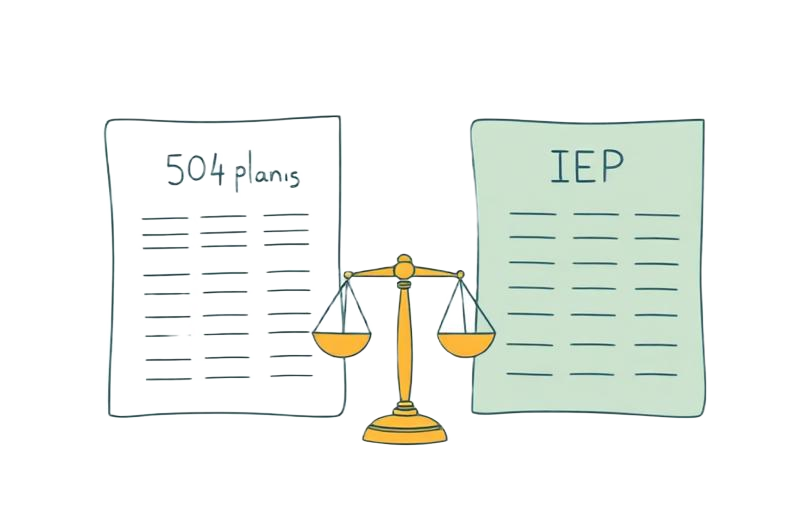
Side-by-Side Comparison: 504 Plan vs. IEP
| Criteria | 504 Plan | IEP |
|---|---|---|
| Federal Law | Section 504 of the Rehabilitation Act (1973) | Individuals with Disabilities Education Act (IDEA) |
| Purpose | Removes barriers to access | Provides specialized instruction and services |
| Eligibility | Any disability that limits a major life activity | Must have 1 of 13 specific disability categories under IDEA |
| What's Provided | Accommodations only | Accommodations + modifications + specialized instruction + related services |
| Goals Required? | No (not required by law) | Yes — measurable annual goals are mandatory |
| Progress Monitoring | Not required (varies by district) | Required — regular progress reports on each goal |
| Parental Consent | Required for evaluation; notification for placement | Written consent required for evaluation, initial placement, and services |
| Dispute Resolution | OCR complaint, mediation, or due process | Mediation, state complaint, or due process hearing under IDEA |
| Funding | No additional federal funding | District receives IDEA Part B funding for eligible students |
| Review Schedule | Periodic review (often annual, not federally mandated) | Annual review required; re-evaluation every 3 years |
What Is a 504 Plan?
A 504 plan is a legally binding document created under Section 504 of the Rehabilitation Act of 1973, a civil rights law that prohibits disability discrimination in any program receiving federal funding — including public schools. Unlike an IEP, a 504 plan does not provide specialized instruction. Instead, it provides accommodations that remove barriers and give students with disabilities equal access to the general education curriculum. (Unsure about terms like FAPE or LRE? See our special education glossary.)
The eligibility criteria for a 504 plan are broader than for an IEP. A student qualifies if they have any physical or mental impairment that substantially limits one or more major life activities — including learning, reading, concentrating, thinking, communicating, and walking. This means conditions like ADHD, anxiety, diabetes, allergies, and chronic illnesses often qualify for 504 plans even when they don't meet IEP criteria.
Common 504 accommodations include extended time on tests, preferential seating, breaks during long assignments, use of assistive technology, modified homework loads, and access to notes or recordings. While 504 plans don't require measurable goals, they should be reviewed periodically and updated as the student's needs change.
What Is an IEP?
An IEP (Individualized Education Program) is a comprehensive educational plan required by the Individuals with Disabilities Education Act (IDEA). It provides specialized instruction, related services (such as speech therapy, occupational therapy, and counseling), accommodations, modifications, and measurable annual goals. For a complete understanding of IEPs, read our detailed guide on what an IEP is and how it works.
To qualify for an IEP, a student must have one of 13 specific disability categories under IDEA and need specialized instruction to make educational progress. An IEP is a legally binding contract — the school must provide every service listed in the document. IEPs offer stronger procedural protections than 504 plans, including specific timelines, required team members, and formal dispute resolution processes.
Key Differences Explained
The most fundamental difference between a 504 plan and an IEP is the type of support they provide. A 504 plan ensures equal access — it levels the playing field through accommodations. An IEP goes further by providing specially designed instruction tailored to the child's unique learning profile.
Think of it this way: a 504 plan changes the environment to fit the child (giving them more time, a different seat, or a quiet testing room). An IEP changes the instruction itself — modifying what is taught, how it's taught, and providing additional services like therapy and counseling to address the underlying challenges.
Another critical difference is accountability. IEPs require measurable annual goals with regular progress monitoring and reporting. Schools must demonstrate that the child is making meaningful progress toward each goal. 504 plans typically have no such requirements, making it harder for parents to track whether accommodations are actually helping.
Legal protections also differ significantly. Under IDEA, parents must give written consent before any changes to their child's IEP. Under Section 504, schools only need to notify parents of changes — consent isn't always required for continued placement. If disputes arise, IDEA provides a structured due process system; 504 disputes go through the Office for Civil Rights (OCR) complaint process.
Which One Does My Child Need?
The right plan depends on your child's specific situation. Use this decision framework to help determine which path to explore:
Your child likely needs an IEP if:
- They have a diagnosed disability in one of the 13 IDEA categories
- They are performing significantly below grade level despite classroom interventions
- They need specialized instruction — not just accommodations — to learn
- They need related services like speech therapy, occupational therapy, or behavioral support
- They need modified curriculum or alternative assessments
A 504 plan may be more appropriate if:
- Your child has a disability or health condition that affects school performance but doesn't require specialized instruction
- They are performing at or near grade level but need accommodations to maintain that performance
- They have conditions like ADHD, anxiety, diabetes, or allergies that require environmental adjustments
- They were evaluated for an IEP but didn't qualify (they may still qualify for a 504)
Not sure which plan fits your child? Take our 2-minute 504 vs IEP quiz to get a personalized recommendation based on your child's specific situation.
How to Request Either Plan
For an IEP evaluation, submit a written request to your school's special education director or principal. Under IDEA, the school must respond within a specific timeframe (usually 15 school days) with either agreement to evaluate or written notice of refusal. If they agree, you'll sign consent, and the evaluation must be completed within 60 calendar days in most states. Use our Parent Rights Letter Builder to generate a formal request letter.
For a 504 plan, submit a written request to your school's 504 coordinator (often the school counselor or assistant principal). Unlike the IEP process, there are fewer federal requirements for 504 timelines, so response times vary by district. Provide supporting documentation from your child's doctor, therapist, or psychologist documenting the disability and its impact on major life activities.
Can a Child Have Both a 504 Plan and an IEP?
No, a student cannot have both plans simultaneously. An IEP already includes all the protections and accommodations a 504 plan would provide, plus specialized instruction, services, and measurable goals. If your child qualifies for an IEP, that is always the more comprehensive option. However, if a child is evaluated for an IEP and found ineligible, the team should consider whether a 504 plan is appropriate — the broader eligibility criteria mean many children who don't qualify for IEPs do qualify for 504 accommodations.
Frequently Asked Questions
Not Sure Which Plan Fits Your Child?
Take our quick quiz to get a personalized recommendation based on your child's needs.
Take the 2-Minute Quiz →Reviewed by our Special Education Advisory Team
Our articles are reviewed by a team of certified special education teachers, Board Certified Behavior Analysts (BCBAs), and parent advocates with combined experience supporting thousands of families through the IEP process.
Was this article helpful?
Related Resources
What Is an IEP? Complete Guide
Everything parents need to know about IEPs.
How to Request an IEP Evaluation
Step-by-step guide to requesting an evaluation.
Help an ADHD Child Focus & Sit Still for Homework
Pillar guide with 24 focus tools.