What Is an IEP? The Complete Parent's Guide to Individualized Education Programs
Quick Answer
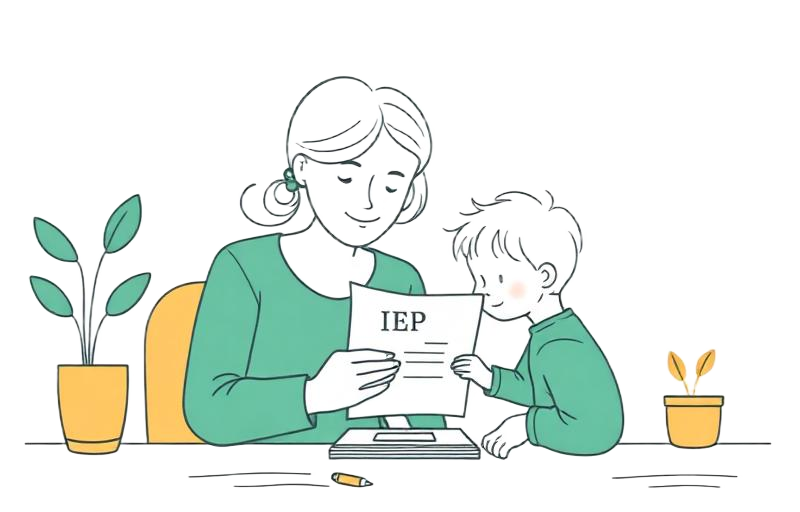
An IEP (Individualized Education Program) is a legally binding document that outlines the special education services, accommodations, and measurable goals a public school must provide to a child with a qualifying disability under the Individuals with Disabilities Education Act (IDEA). Every IEP is customized to the individual child's needs.
What Is an IEP?
An Individualized Education Program (IEP) is the cornerstone document of special education in the United States. Required by the Individuals with Disabilities Education Act (IDEA), an IEP is a written plan developed by a team of professionals and the child's parents that describes the educational program designed to meet a child's unique needs. (New to the acronyms? Bookmark our special education glossary.)
Unlike general education plans, an IEP is a legally binding contract between the school district and the family. The school is required by federal law to provide every service, accommodation, and support listed in the IEP — and parents have legal recourse if the school fails to implement it. This makes the IEP one of the most powerful tools available to parents of children with disabilities.
An IEP covers far more than just academics. It can address communication, social skills, behavior, motor skills, daily living skills, and transition planning for life after high school. The program is reviewed and updated at least once per year, with a full re-evaluation every three years to determine whether the child continues to qualify for services.
Who Qualifies for an IEP?
To qualify for an IEP, a child must meet two criteria: (1) they must have one of the 13 disability categories recognized under IDEA, and (2) the disability must adversely affect their educational performance to the degree that they require specialized instruction to make progress.
The 13 IDEA disability categories are:
- Autism — Developmental disability affecting communication and social interaction
- Deaf-Blindness — Combination of hearing and visual impairments
- Deafness — Severe hearing impairment
- Emotional Disturbance — Conditions affecting educational performance over an extended period
- Hearing Impairment — Hearing loss not covered under deafness
- Intellectual Disability — Significantly below-average general intellectual functioning
- Multiple Disabilities — Combination of impairments causing severe educational needs
- Orthopedic Impairment — Physical disabilities affecting educational performance
- Other Health Impairment — Includes ADHD, epilepsy, and other chronic health conditions
- Specific Learning Disability — Includes dyslexia, dyscalculia, and dysgraphia
- Speech or Language Impairment — Communication disorders
- Traumatic Brain Injury — Acquired brain injuries affecting educational performance
- Visual Impairment — Including blindness
It's important to understand that having a diagnosis alone does not guarantee an IEP. The evaluation team must determine that the disability adversely affects educational performance and that the child needs specially designed instruction — not just accommodations — to make meaningful progress.
What Must an IEP Include? (8 Required Components)
Federal law requires every IEP to include these eight components:
- Present Levels of Academic Achievement and Functional Performance (PLAAFP) — A comprehensive snapshot of the child's current skills, strengths, and challenges. This section forms the foundation of the entire IEP and should include data from evaluations, classroom observations, teacher input, and parent feedback.
- Measurable Annual Goals — Specific, achievable objectives the child should reasonably accomplish within one school year. Each goal must be measurable so progress can be tracked objectively. Goals should align with the needs identified in the PLAAFP. Use our IEP Goal Generator for properly formatted examples.
- Special Education and Related Services — The specific instruction and services the child will receive, such as speech-language therapy, occupational therapy, behavioral interventions, counseling, or specialized academic instruction.
- Accommodations and Modifications — Changes to the learning environment, curriculum, or testing that help the child access education. Accommodations change how a child learns; modifications change what a child is expected to learn. Find appropriate options with our Accommodation Finder.
- Participation with Non-Disabled Peers — An explanation of the extent to which the child will be educated alongside peers without disabilities. IDEA presumes the least restrictive environment (LRE) — meaning children should be in general education settings to the maximum extent appropriate.
- Assessment Accommodations — How the child will participate in state and district-wide assessments, including any accommodations needed or whether an alternate assessment is appropriate.
- Service Dates, Frequency, and Duration — The specific start date, frequency (e.g., 30 minutes, 3 times per week), location (e.g., resource room, general education classroom), and duration of each service.
- Transition Planning (required by age 16) — Measurable post-secondary goals related to education, employment, and independent living, along with the transition services needed to help the student reach those goals.
How the IEP Process Works
The IEP process follows a structured sequence mandated by federal law. Understanding each step empowers you to advocate effectively for your child throughout the process.
Step 1: Referral for Evaluation
Either a parent or school staff can request an evaluation for special education services. Parents should put this request in writing and send it to the school principal and special education director. The school has a limited timeframe to respond — they must either agree to evaluate or provide written notice explaining why they're declining. Use our Parent Rights Letter Builder to create a formal evaluation request.
Step 2: Evaluation
Once parents consent to the evaluation, the school has 60 calendar days (in most states) to complete a comprehensive assessment. The evaluation must assess all areas of suspected disability and use multiple assessment tools — not just a single IQ test. Parents can request an Independent Educational Evaluation (IEE) if they disagree with the school's findings.
Step 3: Eligibility Determination
The evaluation team, including the parents, reviews the assessment results to determine whether the child qualifies under one of the 13 IDEA categories and needs specialized instruction. If eligible, the process moves to IEP development.
Step 4: IEP Development Meeting
Within 30 days of eligibility determination, the IEP team meets to develop the initial IEP. The team includes parents, at least one general education teacher, at least one special education teacher, a school district representative, and someone who can interpret evaluation results. Parents are equal members of this team.
Step 5: Implementation
Once parents provide written consent, the school must begin implementing all services described in the IEP. Every teacher and service provider working with the child must have access to the IEP and understand their responsibilities.
Step 6: Annual Review and Re-Evaluation
The IEP must be reviewed at least once per year to assess progress and update goals. A full re-evaluation occurs every three years (or sooner if requested) to determine continued eligibility. Parents can request an IEP meeting at any time if they have concerns about their child's progress.
Your Rights as a Parent in the IEP Process
IDEA provides parents with robust procedural safeguards. Understanding these rights is essential to effective advocacy:
- Right to participate — You are an equal member of the IEP team and must be included in all decisions about your child's education.
- Right to prior written notice — The school must notify you in writing before making any changes to your child's identification, evaluation, placement, or services.
- Right to informed consent — The school cannot evaluate your child or begin services without your written consent.
- Right to access records — You can inspect and review all educational records related to your child.
- Right to dispute resolution — If you disagree with the school's decisions, you can use mediation, file a state complaint, or request a due process hearing.
- Right to an Independent Educational Evaluation (IEE) — You can request an outside evaluation at public expense if you disagree with the school's evaluation.
- Right to bring support — You can bring advocates, attorneys, or anyone with expertise about your child to IEP meetings.
How to Prepare for an IEP Meeting
Preparation is the single most impactful thing you can do to improve your child's IEP outcomes. Before each meeting, gather all relevant documents: previous IEPs, evaluation reports, report cards, work samples, and any outside evaluation or therapy reports. Write down your concerns, goals, and questions in advance. Use our comprehensive IEP Meeting Checklist to ensure you don't forget anything critical.
Consider bringing a parent advocate or trusted person for support — research shows families who bring advocates report higher satisfaction with IEP outcomes. During the meeting, take notes or ask permission to record. After the meeting, request a copy of the finalized IEP and review it carefully before signing.
Common Mistakes Parents Make
Even the most engaged parents sometimes make avoidable errors in the IEP process. Here are the most common pitfalls:
- Signing the IEP at the meeting — You are never required to sign the same day. Take the document home, review it carefully, and ask questions before consenting.
- Not putting requests in writing — Verbal requests are difficult to enforce. Always follow up conversations with a written summary sent via email or certified mail.
- Accepting vague goals — Goals like "improve reading" are not measurable. Insist on specific, measurable, achievable, relevant, and time-bound (SMART) goals.
- Not requesting progress reports — You're entitled to regular progress updates on IEP goals. Request quarterly reports that include data, not just checkboxes.
- Going to meetings alone — Schools typically send a team of 5–8 professionals. Having at least one support person helps balance the dynamic and ensures you don't miss important details.
Frequently Asked Questions About IEPs
Ready to Take Action?
Use our free tools to prepare for your child's IEP with confidence.
Reviewed by our Special Education Advisory Team
Our articles are reviewed by a team of certified special education teachers, Board Certified Behavior Analysts (BCBAs), and parent advocates with combined experience supporting thousands of families through the IEP process.
Was this article helpful?
Related Resources
504 Plan vs. IEP: The Complete Comparison
Compare 504 plans and IEPs side-by-side.
How to Request an IEP Evaluation
Step-by-step guide to requesting an evaluation.
Help an ADHD Child Focus & Sit Still for Homework
Pillar guide with 24 focus tools.
Finding the Right Tutor for Your Special Needs Child
What to look for when selecting a specialized tutor.