
Written by
Lead Editor & Special Education Advocate
Clinically reviewed by James Rivera, Ph.D., NCSP
Published October 8, 2026 Updated October 2026
First-Then Board: Free Printable and How to Use It
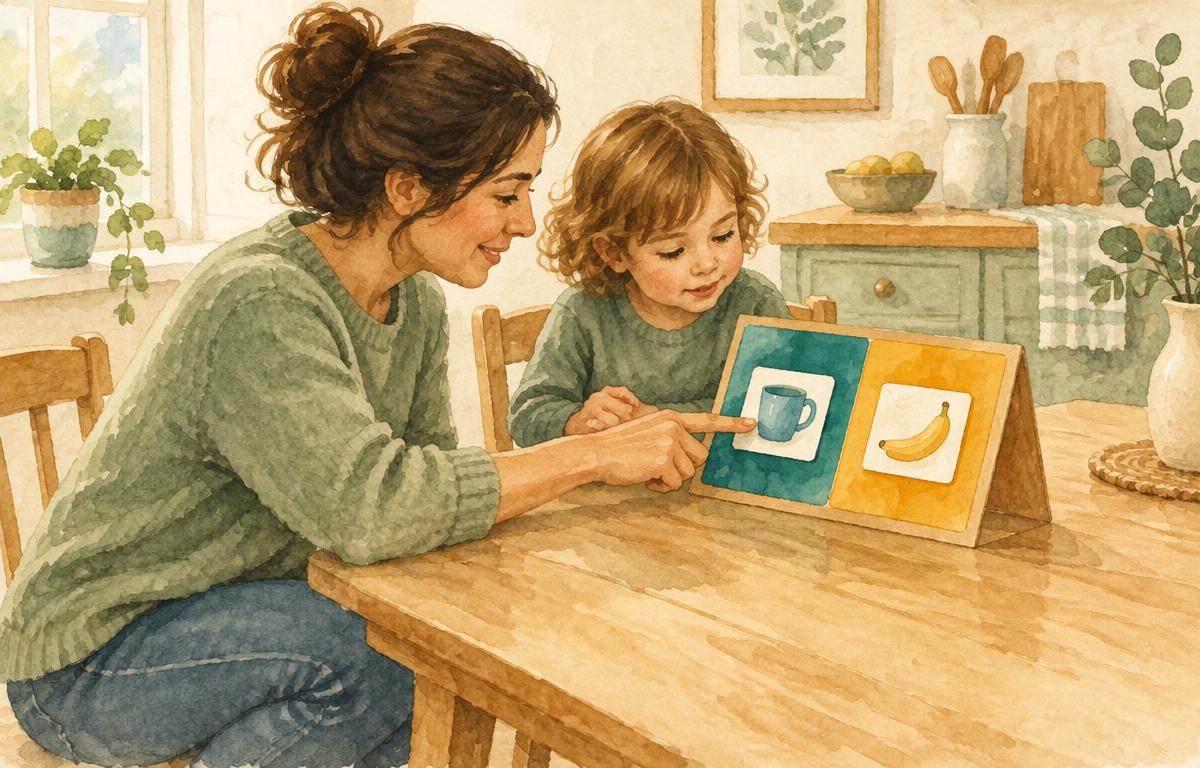
If getting your child from the couch to the bathtub feels like a negotiation you lose every night, you're in good company. For a lot of kids, especially autistic kids, kids with ADHD and little ones who aren't talking much yet, spoken instructions vanish the second they leave your mouth. A first-then board gives those words somewhere to land.
Download the free first-then board (PDF)What a first-then board is
It's a card with two boxes. The left box, "first," shows the task. The right box, "then," shows what comes next, something your child likes. "First shoes, then park." "First two math problems, then Lego." That's the whole tool. It works because it answers the question many kids can't put into words: what's happening, and when do I get to do the thing I want?
Why it works
Two well-studied ideas sit underneath it. The first is the Premack principle: a preferred activity can motivate a less-preferred one when it follows directly after. Psychologist David Premack described it in the 1950s, and it still shows up in almost every behavior plan written today.
The second is visual supports. Pictures stay put while words disappear, which helps kids who process language slowly, get anxious about the unknown, or struggle with working memory. The National Clearinghouse on Autism Evidence and Practice lists visual supports among its evidence-based practices for autistic children and youth, and the free AFIRM visual supports module from UNC walks through how teachers use them.
How to use it, step by step
- Start with a win. For the first few days, pick an easy "first" task your child usually does anyway, so they learn the board means good things happen.
- Keep the first task small. "Put on one shoe" beats "get ready for school." You can stretch it later.
- Make the "then" truly motivating. Watch what your child reaches for when they're free to choose. That's your list.
- Use very few words. Point and say, "First bath, then book." Skip the explanations and the "okay?" at the end.
- Follow through immediately. The moment the task is done, hand over the "then." A delay breaks the link.
- Remove the first card when it's done. Pulling the finished picture off gives a clear, satisfying "done" signal.
Real-life examples
| Situation | First | Then |
|---|---|---|
| Homework | 5 spelling words | 10 minutes of drawing |
| Morning routine | Get dressed | Breakfast |
| Screen transitions | Tablet off | Snack |
| Errands | Grocery store | Playground |
| Bedtime | Brush teeth | Two stories |
Screen transitions are where many parents get the most mileage. If the new research on screen time and child development has you trying to cut back, putting a calm, enjoyable "then" after "tablet off" softens one of the hardest moments of the day.
What's in the free printable
- Two full-page first-then boards (one for home, one for school or the car)
- A page of 16 cut-out cards: 12 common tasks and rewards plus 4 blanks for your own
Laminate the pages or slip them into a sheet protector, add Velcro dots, and the cards become reusable. Photos of your child's actual toothbrush or favorite park often work better than drawings for younger kids.
Download the free first-then board (PDF)When it isn't working
- The reward isn't strong enough. Try something else, and save a favorite activity just for board time.
- The task is too big. Cut it in half, then in half again.
- It only comes out during meltdowns. Use it during calm moments too, so it isn't linked to stress. A child mid-meltdown needs comfort first, not a board.
- The rules keep changing. If "then" sometimes disappears, the board loses its meaning fast. Only promise what you can deliver.
Bringing it into the IEP
If the board works at home, ask the school to use one too. Visual supports and visual schedules are common accommodations, and our Accommodation Finder can suggest wording to bring to the meeting. If your child is working on task completion or transitions, the IEP Goal Generator can draft a measurable goal around it, and the IEP meeting checklist keeps your requests in one place.
For kids who need more than a board, a behavior specialist may suggest a fuller plan. If you're unsure whether the school's evaluation captured your child's needs, read our guide to requesting an independent educational evaluation.
Frequently asked questions
Sarah has represented families in more than 400 IEP meetings and specializes in translating IDEA and Section 504 into plain language. She holds an M.Ed. in Special Education and completed COPAA's Special Education Advocate Training (SEAT). Before advocacy, she taught in K–5 inclusion classrooms for eight years.

Dr. Rivera has conducted over 1,500 psychoeducational evaluations across public and private school settings. He specializes in ADHD, specific learning disabilities, autism, and functional behavior assessment (FBA). He reviews evaluation, eligibility, and behavior-related content for IEP Tutor.
Was this article helpful?
Related Resources
How to Help a Child with ADHD Focus
Routines and 24 focus tools for homework and school.
Sensory Toys for Toddlers with Autism
Therapist-informed picks for ages 2 to 4.
15 Classroom Strategies for ADHD
Teacher-tested supports, including visual tools.